
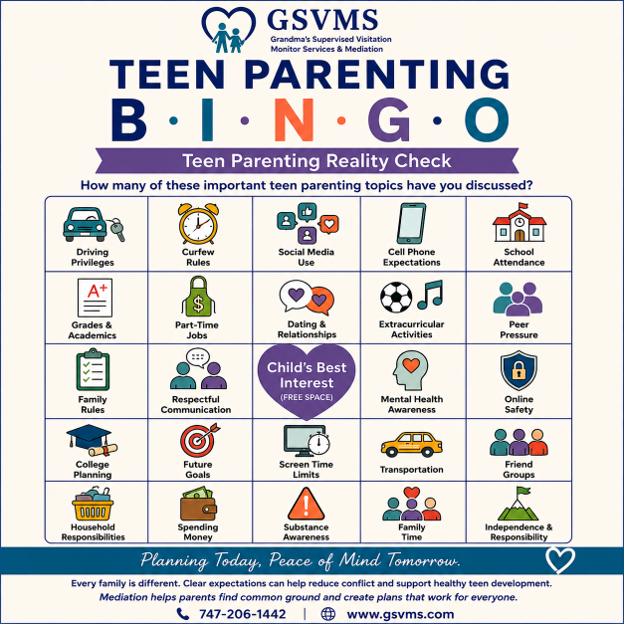
Teen Parenting Reality Check Conversations Every Parent Should Have During the Teen Years - The GSVMS Co-Parenting Bingo Series #4
The teenage years can be exciting, rewarding, and challenging—for teens and for the adults guiding them. As children grow into young adults, everyday parenting decisions begin to involve greater independence, increased responsibility, stronger opinions, and choices that may have longer-term consequences. For co-parents, this stage can also bring a new set of questions that were not part of the original parenting plan.
Driving privileges, curfews, social media, dating, part-time jobs, school responsibilities, transportation, and plans after high school are just some of the issues families may suddenly find themselves navigating.
Our GSVMS Parenting BINGO series takes everyday parenting and co-parenting challenges and turns them into practical conversation starters. After exploring earlier family and back-to-school challenges, this edition focuses on the teenage years — when driving, curfews, social media, dating, jobs, school, and growing independence can introduce an entirely new set of parenting decisions.
The Teen Parenting Reality Check BINGO card is designed as a practical conversation starter: a way to identify which topics have already been discussed and which ones may need more attention before they become sources of conflict.
Why the Teen Years Can Change Co-Parenting
A parenting arrangement that worked well when a child was eight may not address what that same child needs at fifteen or seventeen. Teenagers have changing schedules, friendships, extracurricular activities, jobs, transportation needs, technology, and increasing expectations of independence. At the same time, they still need boundaries, guidance, stability, and parents who remain involved.
When parents live in separate households, differences in expectations can become more noticeable. One home may allow a later curfew. One parent may be comfortable with a teen driving friends, while the other is not. Parents may have different rules about dating, phones, social media, spending money, or employment. These differences do not automatically mean that either parent is wrong, but unresolved differences can create confusion for the teenager and unnecessary conflict between adults.
Driving: Freedom Comes With Responsibility
For many teenagers, learning to drive represents a major step toward independence. For parents, it can raise practical and safety questions. Who will teach the teen to drive? Which vehicle can they use? Who is responsible for insurance, fuel, maintenance, and driving-related expenses? Are passengers allowed? What happens if the teen receives a ticket or violates a household driving rule?
Co-parents do not have to agree on every detail, but discussing expectations before a license is issued can prevent the teenager from being caught between two different sets of assumptions. Safety requirements and legal restrictions should always come first, followed by clear family expectations that the teen can understand.
Curfews and Growing Independence
Curfews often become a balancing act between trust and supervision. A reasonable curfew may depend on the teenager’s age, maturity, activity, transportation, school schedule, and history of responsible behavior. Problems can arise when a teen discovers that one household has significantly different rules from the other and begins using those differences as leverage.
Rather than focusing only on the clock, parents can discuss the purpose behind the rule: safety, communication, adequate sleep, school responsibilities, and knowing where the teenager is. It is also useful to agree on what the teen should do if plans change or they are going to be late.
Social Media, Phones, and Online Life
Technology is woven into teenage social life, schoolwork, entertainment, and communication. Parents may need to consider screen time, privacy, inappropriate content, online bullying, location sharing, posting photographs, communication with strangers, and what happens when technology interferes with sleep or school.
Separated parents may also need to consider whether a teenager’s phone becomes a source of conflict between households. A teen should not be placed in the middle by being asked to report on the other parent, carry adult messages, or use technology to monitor what is happening in another household. Clear, age-appropriate expectations can help technology remain a useful tool rather than another source of family tension.
Dating and Relationships
Teen dating can bring questions about age, supervision, transportation, sleepovers, appropriate boundaries, and how parents will respond when a relationship becomes serious. Even when parents have different personal views, teenagers benefit when adults can communicate expectations calmly and focus on safety, respect, consent, healthy relationships, and age-appropriate decision-making.
This is also an area where listening matters. Teenagers are more likely to seek guidance when they believe they can talk without every conversation immediately becoming a confrontation.
Part-Time Jobs, Money, and Responsibility
A first job can be an excellent opportunity for a teenager to develop independence, time-management skills, and financial responsibility. It can also affect schoolwork, transportation, extracurricular activities, and parenting schedules.
Parents may want to discuss how many hours the teen can reasonably work, transportation to and from work, whether work can interfere with scheduled parenting time, and expectations for saving or spending earnings. When both households understand the plan, the teenager is less likely to feel forced to choose between work responsibilities and family obligations.
School, College, and Planning for What Comes Next
As high school progresses, conversations may shift toward grades, graduation requirements, college visits, vocational training, applications, financial aid, employment, or other plans after graduation. These decisions can involve significant time, travel, and expense.
Parents can help by beginning these discussions early. Who will attend college tours? How will application fees or travel costs be handled? What happens if parents have different opinions about a school or career choice? Early discussion does not guarantee agreement, but it gives families time to identify differences and work through them before deadlines create additional pressure.
Consistency Matters—But Identical Rules Are Not Always Realistic
In two-household families, perfectly identical rules are often unrealistic. Different homes may have different schedules, expectations, and routines. What matters most is that the teenager understands the rules in each home and is not encouraged to manipulate one parent against the other.
Consistency is especially valuable around issues involving safety, school attendance, illegal behavior, driving, substance use, and major responsibilities. When parents can agree on a few core expectations, teenagers receive a clearer message about the boundaries that matter most.
Teen Parenting Reality Check BINGO
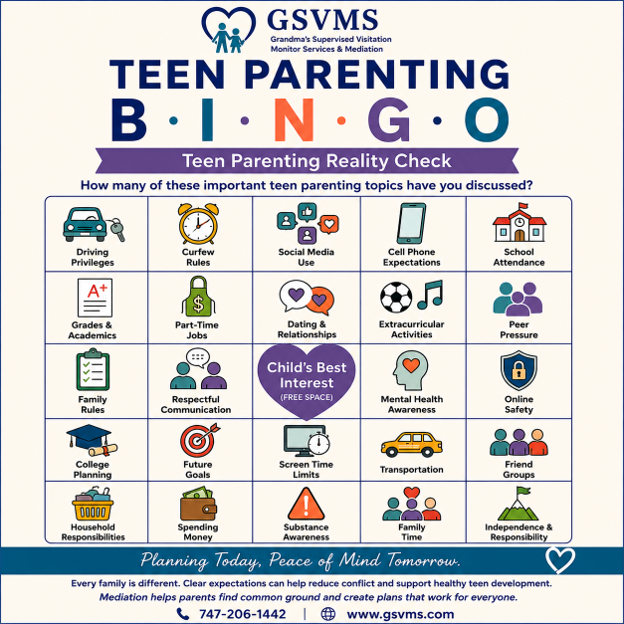
How to Play Teen Parenting Reality Check BINGO
Read through each square on the Teen Parenting Reality Check BINGO card and check off the topics your family has already discussed or agreed upon.
Five checked squares in a row — across, down, or diagonally — gives you BINGO!
The real goal is not simply to win. Use any unchecked squares as conversation starters for topics that may need more discussion as your teenager becomes more independent.
How many boxes can you check?
Have you already talked about driving, curfews, social media, dating, jobs, school responsibilities, money, and plans for the future?
Count your boxes and see how close you are to BINGO!
Which squares are still waiting to be discussed?
Keep the Teen Out of Adult Conflict
Teenagers are old enough to understand much more about family conflict than younger children, but that does not mean they should be drawn into it. Asking a teen to take sides, deliver messages, report on the other household, or choose which parent is “right” places an unfair emotional burden on them.
A teenager can have a voice about their needs and schedule without becoming the decision-maker for adult disputes. Parents can listen carefully to what the teen is saying while still keeping responsibility for adult communication and problem-solving where it belongs—with the adults.
When the Parenting Plan Needs to Grow With the Child
Sometimes the issue is not simply a disagreement about a rule. The existing parenting plan may no longer reflect the realities of a teenager’s life. School activities, sports, employment, transportation, social events, and college preparation can all create scheduling needs that did not exist when the original plan was written.
When parents repeatedly struggle with the same issues, it may be helpful to review the parenting plan and identify where more detail or flexibility is needed. Mediation can provide a structured setting for parents to discuss those changes and work toward practical, child-focused solutions without making the teenager responsible for resolving the disagreement.
Use the BINGO Card as a Conversation Starter
The goal of the Teen Parenting Reality Check BINGO card is not to suggest that every family must have the same rules. It is designed to help parents notice the topics that may otherwise be overlooked until a problem occurs.
Look at the squares together and ask: Have we discussed this? Do we have a shared expectation? Does our teenager understand the rule? Is this something that needs to be revisited as they get older? A simple conversation today can prevent a much more difficult argument later.
Planning Ahead Supports Teenagers
Teenagers are developing independence, but they still benefit from knowing that the adults around them are paying attention, communicating, and setting thoughtful boundaries. Planning ahead can reduce uncertainty, help parents respond more consistently, and give teenagers a clearer framework for making responsible choices.
The teen years do not have to become a constant series of conflicts. With communication, realistic expectations, and a willingness to revisit parenting arrangements as children mature, parents can help teenagers move toward adulthood with greater stability and confidence.
At GSVMS — Grandmas Supervised Visitation Monitors & Mediation Services, our focus is on practical, child-centered solutions that help families plan ahead, reduce conflict, and keep children and teenagers out of adult disputes. If co-parenting issues are becoming difficult to resolve, mediation can help parents work through concerns in a structured and productive setting.
Call To Action
If parenting or co-parenting conversations about a teenager’s changing needs are becoming difficult, mediation can help parents work toward practical agreements while keeping their child’s best interests at the center of the discussion.
GSVMS provides mediation services throughout California via Zoom and supervised visitation services throughout Southern California.
📞 747-206-1442 🌐 www.gsvms.com