
New Co-Parent Starter Guide: Conversations to Have When Building a Co-Parenting Foundation - The GSVMS Co-Parenting Bingo Series #12
Start With the Basics
The New Co-Parent Starter Guide helps parents begin important conversations about schedules, communication, exchanges, school, medical information, expenses, and boundaries. The beginning of a co-parenting relationship can set the tone for years to come. Clear expectations, realistic boundaries and child-focused communication can reduce uncertainty and help both households build a workable foundation.
This post is part of the GSVMS Co-Parenting BINGO series: practical conversation starters designed to help families identify issues before they become unnecessary sources of conflict.
Before focusing on rare situations, make sure the everyday plan is clear: regular schedule, exchanges, school responsibilities, childcare, medical information and communication methods.
Set Communication Expectations
Parents do not have to communicate constantly, but they do need a reliable way to exchange important information. Agreeing on a method and reasonable response expectations can prevent repeated misunderstandings.
Discuss Money Before It Becomes a Crisis
School costs, activities, childcare, transportation and unexpected expenses can create conflict when no process exists. Early conversations about responsibility and documentation can help.
Build in Respectful Boundaries
Healthy co-parenting does not require access to every detail of the other household. Clear boundaries help adults focus on information that genuinely affects the child.
Create a Shared Information Foundation
New co-parents should make sure both households have essential information: school contacts, medical providers, allergies, medications, activity schedules and emergency numbers. Information should not depend on memory or on the child carrying it back and forth.
A simple shared record or agreed communication system can prevent repeated questions and help both parents respond appropriately when something changes.
Decide How Changes Will Be Requested
Schedule changes are normal. Problems arise when requests are vague, last-minute or assumed to be accepted without a response. Establish how requests will be made and when an answer is needed.
A consistent process reduces personal interpretation and makes it easier to distinguish a request from a confirmed change.
Respect the Other Household’s Parenting Time
Co-parenting works better when each household can function without unnecessary interference. Unless there is a safety issue or a court-order requirement, routine parenting decisions during the other parent’s time generally should not become constant supervision by the other household.
Respectful boundaries create space for both parents to build their own relationship with the child.
Expect the Plan to Evolve
A first parenting plan is a starting structure, not a prediction of every future need. Children grow, work schedules change, schools change and new activities appear.
Building a habit of reviewing the plan and discussing changes constructively can be more valuable than trying to anticipate every possible issue on day one.
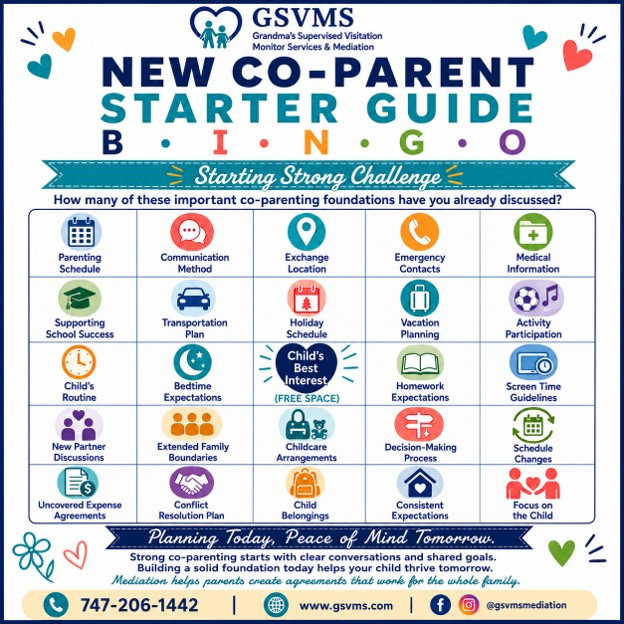
New Co-Parent Starter Guide BINGO
⬇️ INSERT APPROVED BINGO GRAPHIC HERE ⬇️
How to Play
Check each square that your family has already discussed or addressed. Five in a row—across, down, or diagonally—is BINGO. The unchecked squares are not failures; they are conversation starters that may reveal topics worth discussing before a problem develops.
How Many Boxes Can You Check?
Compare your completed squares and notice which subjects still need attention. The goal is not to “win” every square. The real value is identifying decisions early, communicating clearly and keeping children at the center of the planning process.
Call To Action
If these conversations are becoming difficult, GSVMS mediation services can help parents work through practical parenting and co-parenting issues in a structured setting.
GSVMS — Grandmas Supervised Visitation Monitors & Mediation Services provides mediation by Zoom and supervised visitation services throughout Southern California.
747-206-1442 • www.gsvms.com
Planning Today, Peace of Mind Tomorrow.