
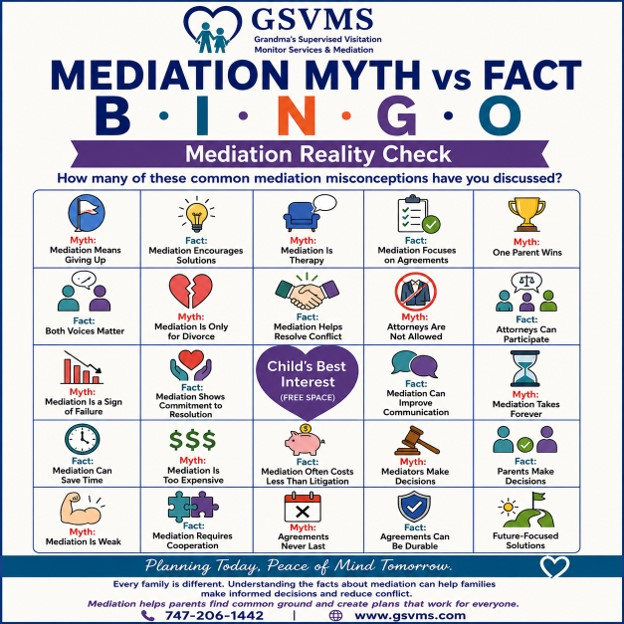
Mediation Myth vs Fact: What Co-Parents Should Know Before Mediation - The GSVMS Co-Parenting Bingo Series #7
Myth: The Mediator Decides the Outcome
Mediation is often misunderstood. Some people assume it is a courtroom substitute where a mediator decides who is right, while others believe mediation only works when everyone already agrees. Neither assumption reflects how mediation is actually designed to work.
Mediation Myth vs Fact Co-Parenting is easier to navigate when parents discuss expectations early, communicate clearly, and keep decisions focused on their child’s needs.
This post is part of the GSVMS Co-Parenting BINGO series: practical conversation starters designed to help families identify issues before they become unnecessary sources of conflict.
A mediator does not declare a winner or impose a parenting plan. The mediator helps participants identify issues, exchange information, explore options and work toward agreements they can accept.
Myth: Mediation Means Giving In
Compromise is not the same as surrender. Productive mediation helps participants evaluate priorities, practical limits and possible solutions rather than simply defending positions.
Fact: Mediation Can Improve Communication
Even when every issue is not resolved, a structured conversation can clarify misunderstandings and help parents develop a more workable way to discuss future problems.
Fact: Preparation Matters
Mediation works best when participants know what decisions need to be made, bring relevant information and arrive prepared to consider realistic options.
Mediation Is Not Therapy
Mediation may improve communication, but it is not designed to diagnose relationships or provide mental-health treatment. The mediator keeps the conversation focused on decisions, options and agreements.
When emotional issues are affecting decision-making, families may use mediation alongside appropriate legal, therapeutic or other professional support. Each service has a different role.
Mediation Can Address Practical Details
Many disputes become easier when they are broken into specific decisions: schedules, exchanges, school events, travel, communication, expenses or holiday arrangements. Mediation creates a structure for addressing one issue at a time.
Specific agreements are generally easier to follow than broad promises to “communicate better.” Clear details help both participants understand what will happen next.
Agreement Must Be Voluntary
A mediator can help participants explore options, but the participants decide whether to agree. The process works best when people understand the proposals they are considering and have an opportunity to ask questions.
Depending on the situation, participants may also choose to obtain independent legal advice before finalizing an agreement. Mediation and legal advice can serve different purposes.
Even Partial Progress Can Help
Not every mediation resolves every issue in one session. Sometimes the useful result is agreement on several practical points, better understanding of the remaining disagreement, or a clearer list of information that is still needed.
Reducing the number of unresolved issues can still save time, lower conflict and make future discussions more focused.
Mediation Myth vs Fact BINGO
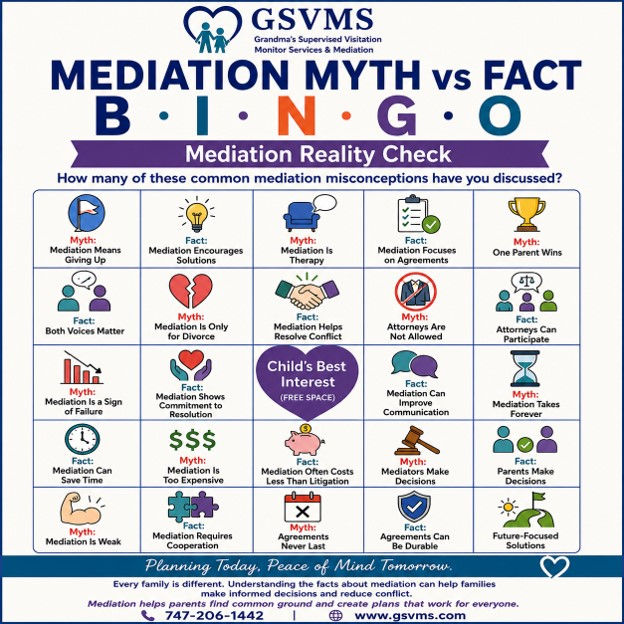
How to Play
Check each square that your family has already discussed or addressed. Five in a row—across, down, or diagonally—is BINGO. The unchecked squares are not failures; they are conversation starters that may reveal topics worth discussing before a problem develops.
How Many Boxes Can You Check?
Compare your completed squares and notice which subjects still need attention. The goal is not to “win” every square. The real value is identifying decisions early, communicating clearly and keeping children at the center of the planning process.
Call To Action
If these conversations are becoming difficult, GSVMS mediation services can help parents work through practical parenting and co-parenting issues in a structured setting.
GSVMS — Grandmas Supervised Visitation Monitors & Mediation Services provides mediation by Zoom and supervised visitation services throughout Southern California.
747-206-1442 • www.gsvms.com
Planning Today, Peace of Mind Tomorrow.