
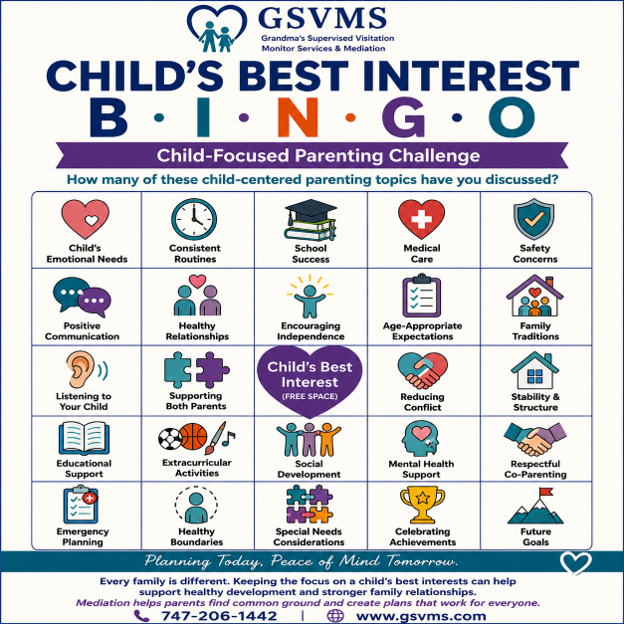
Child's Best Interest: Conversations Every Co-Parent Should Have About Child-Focused Decisions - The GSVMS Co-Parenting Bingo Series #6
Stability and Predictability Matter
Parents often hear the phrase “best interests of the child,” but it becomes meaningful through everyday decisions. Stability, safety, emotional support, school success, healthy relationships and freedom from adult conflict all contribute to a child-focused approach.
Child’s Best Interest Co-Parenting is easier to navigate when parents discuss expectations early, communicate clearly, and keep decisions focused on their child’s needs.
This post is part of the GSVMS Co-Parenting BINGO series: practical conversation starters designed to help families identify issues before they become unnecessary sources of conflict.
Children generally benefit from knowing what comes next. Predictable schedules, clear exchanges, dependable school attendance and reliable communication help create security even when the two households have different routines.
Protect Emotional Well-Being
Children should not be asked to carry messages, choose sides, report on the other household or reassure a parent about adult disagreements. They benefit when adults keep adult issues in adult conversations.
Education, Health and Safety
School information, medical care, medications, allergies, emergency contacts and safety expectations are practical areas where information-sharing matters. Each household should have the information needed to make safe decisions.
Support Healthy Relationships
A child can have meaningful relationships with both parents and extended family. Encouraging those relationships, when appropriate and safe, helps children avoid loyalty conflicts and supports emotional security.
Look at the Whole Child
A child’s best interests are broader than one schedule or one disagreement. Physical safety, emotional security, education, health, relationships, culture, age, temperament and developmental needs may all matter. What works for one child may not work for a sibling or for the same child several years later.
Parents can ask whether the current arrangement supports the child’s actual life today rather than relying only on what worked in the past. Child-focused planning should be reviewed as children grow and their needs change.
Consistency Without Identical Households
Children can adapt to different rules in different places when those rules are reasonable and predictable. One home may have a slightly different bedtime or homework routine without harming the child. The difficulty comes when rules are used to undermine the other household or when expectations change constantly.
Instead of trying to make two homes identical, parents can identify the areas where consistency matters most, such as school attendance, medication, safety rules and respectful behavior.
Listen Without Making the Child Decide
Children often have preferences, worries and feelings about parenting arrangements. Listening is important, but listening is not the same as asking the child to make adult decisions. A child can be heard without being placed in charge of the parenting plan.
Parents can acknowledge feelings, ask open questions and avoid promising outcomes before adults have discussed the issue. This helps the child feel valued without creating responsibility for the final decision.
Revisit Decisions as Children Grow
A parenting arrangement that made sense in elementary school may need adjustment in middle school or high school. Activities, friendships, transportation, homework and social development can change dramatically.
Regularly reviewing the plan can prevent normal developmental changes from becoming crises. The question is not whether the old plan was wrong; it is whether the current plan still serves the child well.
Child's Best Interest BINGO
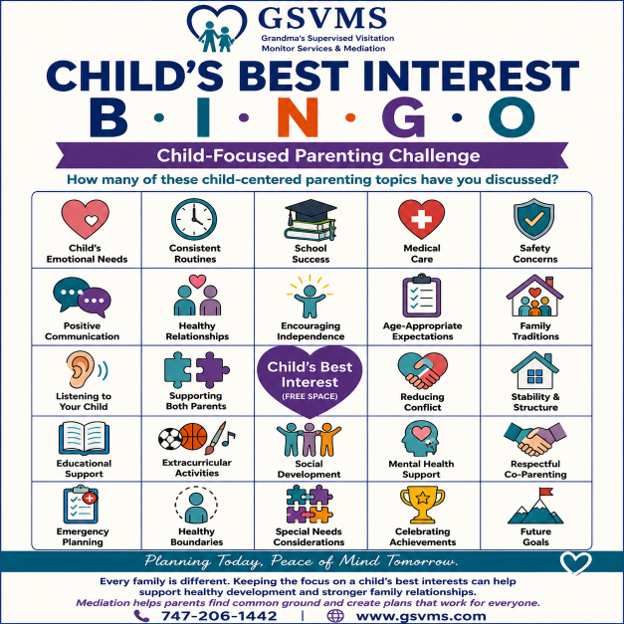
How to Play
Check each square that your family has already discussed or addressed. Five in a row—across, down, or diagonally—is BINGO. The unchecked squares are not failures; they are conversation starters that may reveal topics worth discussing before a problem develops.
How Many Boxes Can You Check?
Compare your completed squares and notice which subjects still need attention. The goal is not to “win” every square. The real value is identifying decisions early, communicating clearly and keeping children at the center of the planning process.
Call To Action
If these conversations are becoming difficult, GSVMS mediation services can help parents work through practical parenting and co-parenting issues in a structured setting.
GSVMS — Grandmas Supervised Visitation Monitors & Mediation Services provides mediation by Zoom and supervised visitation services throughout Southern California.
747-206-1442 • www.gsvms.com
Planning Today, Peace of Mind Tomorrow.